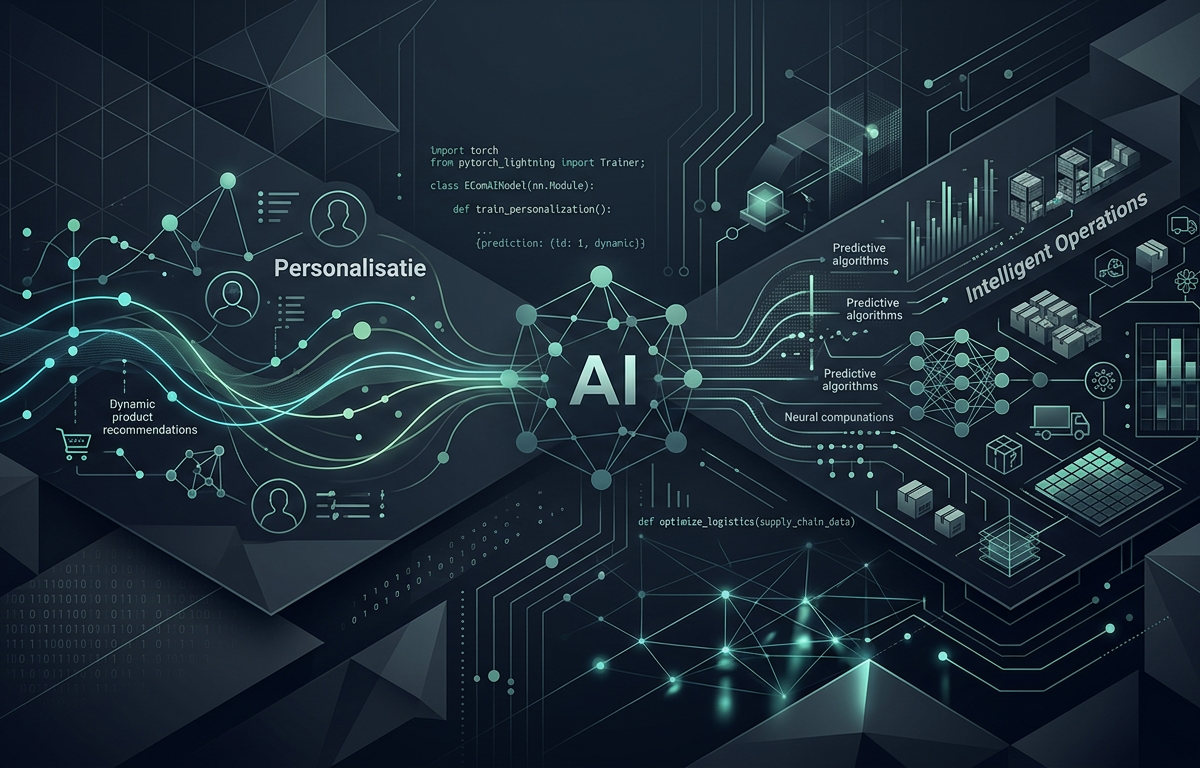
The e-commerce landscape is undergoing a tectonic shift. We are moving away from traditional "search and click" interfaces toward intelligent, predictive, and highly personalized shopping experiences. For CTOs and technical leads, implementing AI is no longer a futuristic goal—it is a technical necessity to maintain operational efficiency and market relevance.
In this deep dive, we explore how Artificial Intelligence is being integrated into modern e-commerce stacks, from semantic search and generative product descriptions to autonomous supply chain optimization.
1. The Evolution of E-commerce Search: From Keywords to Vectors
Traditional e-commerce search relies on keyword matching (Lexical Search). If a user types "crimson running footwear" and the product is tagged as "red shoes," the search might fail. AI-driven search leverages Vector Embeddings and Semantic Search to understand intent.
Vector Search Implementation
By using models like OpenAI’s text-embedding-3-small or open-source alternatives like HuggingFace Transformers, developers can convert product catalogs into high-dimensional vectors. When a user searches, the query is also vectorized, and a vector database (like Pinecone, Milvus, or Weaviate) performs a "cosine similarity" search.
Technical Workflow:
- Ingestion: Product metadata (title, description, attributes) is passed through an LLM.
- Embedding: The LLM returns a numerical vector representing the product's meaning.
- Storage: The vector is stored in a Vector Database.
- Querying: A user query like "outfit for a wedding in Italy" is vectorized and matched against the database.
| Feature | Traditional Search | AI Semantic Search |
|---|---|---|
| Logic | Exact keyword matching | Conceptual understanding |
| Handling Typos | Requires manual fuzzy logic | Native handling via embeddings |
| Long-tail Queries | Often zero results | High relevance for complex queries |
| Maintenance | Extensive synonym libraries | Self-learning and adaptive |
2. Generative AI for Content Operations at Scale
Scaling an e-commerce platform often involves managing thousands of SKUs. Maintaining high-quality, SEO-optimized product descriptions and metadata manually is impossible.
Automated Product Enrichment
Using GPT-4 or Claude 3, developers can build pipelines that ingest raw manufacturer data and output:
- Unique Product Descriptions: Avoiding "duplicate content" penalties from Google.
- Alt-text for Images: Improving accessibility and Image SEO.
- Structured Data (JSON-LD): Automatically generating schema markup for better rich snippet visibility.
Example Python Snippet for Description Generation:
import openai

def generate_product_description(attributes):
    prompt = f"Write a compelling, SEO-friendly 150-word description for a product with these specs: {attributes}"
    response = openai.chat.completions.create(
        model="gpt-4-turbo",
        messages=[{"role": "user", "content": prompt}]
    )
    return response.choices[0].message.content
3. High-Performance Personalization Engines
Static "Recommended for You" blocks based on broad categories are being replaced by real-time inference engines.
Predictive Analytics and User Behavior
By feeding real-time clickstream data (via Segment or Snowplow) into Machine Learning models, e-commerce platforms can predict the Probability of Purchase (pPurchase) or Lifetime Value (LTV) of a visitor in mid-session.
- Dynamic Pricing: Utilizing Reinforcement Learning to adjust prices based on demand, inventory levels, and competitor pricing.
- Affinity Mapping: Using Collaborative Filtering (like the ALS algorithm) to find "lookalike" shoppers and suggest products they purchased.
4. AI in Logistics and Supply Chain: The "Backbone" of E-commerce
Profitability in e-commerce is won or lost in the warehouse. AI-driven automation optimizes the most expensive parts of the business.
Demand Forecasting
Traditional forecasting uses moving averages. AI uses Recurrent Neural Networks (RNNs) or LSTMs (Long Short-Term Memory) to analyze:
- Historical sales data.
- Seasonal trends.
- External factors (weather, economic indicators, social media trends).
Warehouse Automation
Computer Vision (CV) is now used for automated quality control and sorting. Cameras powered by YOLO (You Only Look Once) architectures can identify damaged packaging or incorrect items on conveyor belts with 99.9% accuracy, significantly faster than human inspectors.
5. Conversational Commerce: Beyond Basic Chatbots
The era of "Sorry, I didn't understand that" is over. Modern AI Chatbots utilize RAG (Retrieval-Augmented Generation) to provide accurate, brand-safe customer support and sales assistance.
Building a RAG-based Shopping Assistant
A RAG system connects an LLM to your live inventory and knowledge base.
- User Question: "Do you have any waterproof jackets under €200 available in blue?"
- Retrieval: The system searches the inventory database (SQL or Vector).
- Augmentation: The system provides the found products to the LLM.
- Generation: The LLM drafts a human-like response: "Yes! We have the 'Alpine Explorer' jacket for €189 in blue. It’s in stock and ships today."
6. Visual AI and Virtual Try-On
For fashion and home decor brands, visual uncertainty is the biggest barrier to conversion.
- Visual Search: Allowing users to upload a photo and find similar items in your shop.
- Generative AI Try-On: Using Diffusion Models (like Stable Diffusion) to overlay clothing onto user-uploaded photos accurately, reflecting fabric drape and lighting.
- AR Integration: Utilizing WebGL and AI to project furniture into a user's room via their smartphone camera.
7. Implementation Challenges and Best Practices
While the benefits are clear, technical hurdles remain.
Data Privacy and Compliance
When implementing AI, especially in Europe (GDPR), sensitive user data must be handled carefully.
- Anonymization: Ensure PII (Personally Identifiable Information) is stripped before sending data to third-party LLM providers.
- Private LLMs: Consider hosting open-source models (like Llama 3) on private infrastructure (Azure AI Studio or AWS Bedrock) to keep data within your VPC.
Cost Management (Token Economics)
Running LLM calls for every user interaction can become expensive. To optimize:
- Caching: Use Redis to cache common query responses.
- Model Distillation: Use a large model (GPT-4) to label data, then train a smaller, cheaper model (BERT or custom GPT) for production tasks.
8. The Future: Agentic E-commerce
The next frontier is Autonomous Agents. These are AI systems that don't just recommend products but perform actions. Imagine an agent that monitors a user's pantry via a smart fridge, identifies they are low on milk, compares prices across memberships, and autonomously places the order within a set budget.
For developers, this means shifting focus from building interfaces (UIs) to building robust APIs and Webhooks that AI agents can interact with.
Conclusion
AI for e-commerce is transitioning from a "nice-to-have" plugin to the core engine of the platform. By moving toward vector-based search, automating content loops with Generative AI, and streamlining logistics through predictive modeling, brands can achieve unprecedented levels of efficiency and customer satisfaction.
The secret to success lies not in implementing AI for the sake of AI, but in identifying the high-friction points in the customer journey—be it finding the right product, understanding its features, or receiving it on time—and using the right model to solve that specific problem.
At Dutchify, we specialize in bridging the gap between legacy e-commerce structures and modern AI-driven architectures. The future of commerce is intelligent; make sure your tech stack is ready for it.