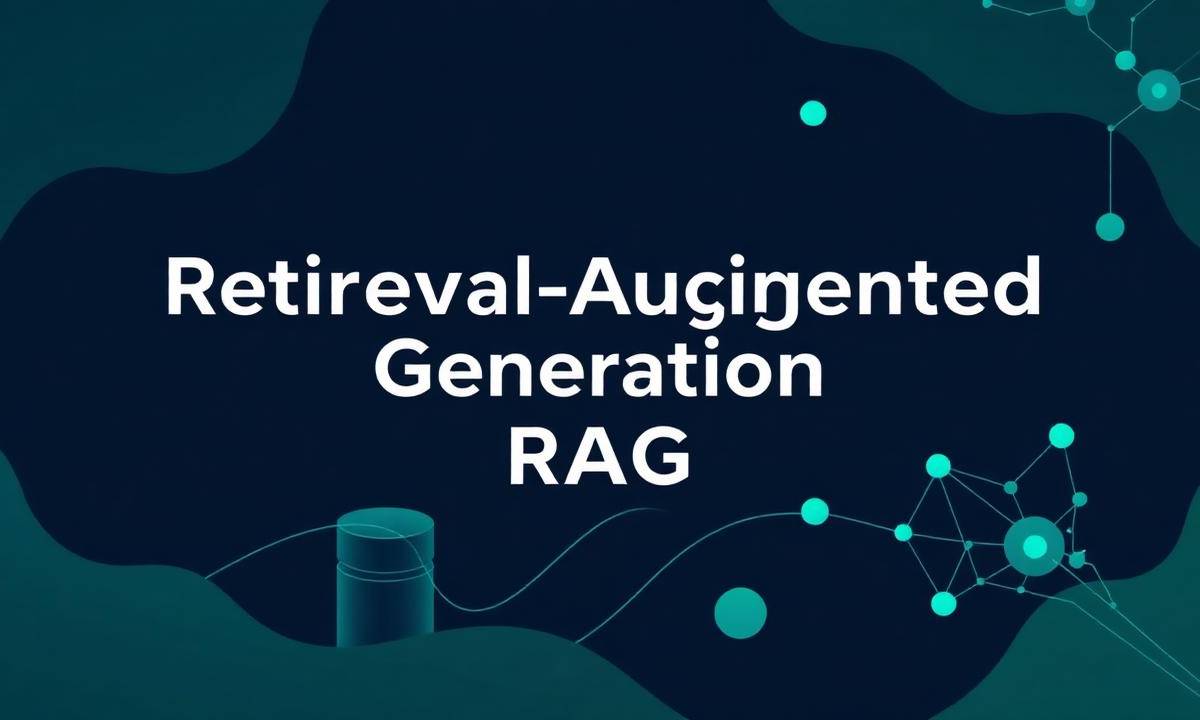
As a leading AI consultancy, Dutchify is witnessing exponential growth in the adoption of advanced AI models, particularly Large Language Models (LLMs). These models possess an unprecedented capacity to understand and generate human language. However, their power comes with inherent limitations: they are restricted to the data they were trained on and can sometimes hallucinate or present outdated information. This is where Retrieval-Augmented Generation (RAG) comes in—a revolutionary architecture that addresses these limitations and sets a new standard for intelligent AI systems.
What is Retrieval-Augmented Generation (RAG)?
Humans are constantly learning new things and updating their knowledge base. LLMs, on the other hand, only "know" what they learned during their training phase. RAG is a method that enables LLMs to retrieve external, up-to-date, and domain-specific information (retrieval) and use it as context for generating responses (generation). This process significantly enriches the output of LLMs, making them more accurate, relevant, and factually correct.
Why is RAG Important?
- Reduction of Hallucinations – LLMs can sometimes produce falsehoods when they cannot find an adequate answer in their training data. RAG significantly reduces this risk by providing the model with factual sources.
- Access to Current Information – LLM training data is, by definition, static and becomes outdated. RAG bridges this gap by providing access to real-time information sources.
- Domain-Specific Knowledge – Companies possess vast amounts of internal knowledge. RAG allows LLMs to leverage this knowledge effectively.
- Transparency and Explainability – Because answers are based on retrieved documents, it is possible to trace and verify the exact sources.
- Cost Savings compared to Fine-Tuning – RAG offers a more flexible and often more cost-efficient way to keep models up-to-date than full retraining.
The Technical Architecture of RAG
1. Data Ingestion and Chunking
The external knowledge base is prepared by gathering data from various sources and splitting it into chunks—smaller, manageable pieces of text. These chunks are essential for efficient retrieval. Typically, they range between 200 and 1,000 tokens, depending on the use case.
2. Embedding Generation
Text chunks are converted into numerical representations called embeddings. These are vectors that capture the semantic meaning of the text in a mathematical space.
from sentence_transformers import SentenceTransformer

model = SentenceTransformer('all-MiniLM-L6-v2')
text_chunks = [
    "RAG enhances Large Language Models by adding external knowledge.",
    "Financial data is stored securely in our database."
]
embeddings = model.encode(text_chunks)
3. Vector Databases
Embeddings are stored in vector databases optimized for fast nearest neighbor searches. Popular options include Pinecone, Weaviate, Milvus, Qdrant, and Faiss.
4. Retrieval – Fetching Context
When a user asks a question, it is converted into an embedding and compared with the stored vectors. The most relevant document chunks are retrieved as context for the language model.
5. Generation – LLM Synthesis
The retrieved chunks are presented to the LLM along with the user question. A typical system prompt looks like this:
You are a helpful assistant that answers questions based on the provided context.
Use only the information from the context to formulate your answer.

Context:
"""
[RETRIEVED TEXT CHUNKS]
"""

User Question: [QUESTION]
This approach guides the model to provide only factual, verifiable answers.
Practical Applications for Businesses
Intelligent Customer Service
Chatbots with access to product documentation, FAQs, and manuals can provide customers with accurate and consistent answers—without the risks of hallucination.
Internal Knowledge Management
Employees can quickly find information within internal documentation, policy papers, and procedures. RAG makes it possible to build an "Ask the Organization" interface that is always up-to-date.
Legal and Compliance Analysis
Rapid analysis of contracts, legislation, and compliance documents with direct source attribution. Ideal for legal departments that need to search through large volumes of text.
RAG vs. Fine-Tuning
| Aspect | RAG | Fine-Tuning |
|---|---|---|
| Cost | Lower (no retraining needed) | Higher (GPU costs for training) |
| Recency | Real-time updates possible | Requires periodic retraining |
| Transparency | High (citations/sources) | Low (black box) |
| Complexity | Medium | High |
| Domain Knowledge | Excellent | Good after extensive training |
Implementation Considerations
- Data Quality – Garbage in, garbage out. Ensure clean, well-structured source data as a foundation.
- Chunking Strategy – Experiment with chunk size and overlap to find the optimal balance between context and precision.
- Embedding Model Selection – Choose a model that fits your language domain. For multilingual needs, models like
multilingual-e5-largeare an excellent choice. - Scalability – Plan ahead for growth in document volume and query load.
- Security – Implement access control at the document level so users only see information they are authorized to access.
Conclusion
RAG is one of the most impactful architectural patterns in modern AI. At Dutchify, our AI automation team helps companies design and implement RAG systems that optimize their knowledge base, minimize hallucinations, and deliver reliable AI experiences — often on a private, self-hosted AI foundation.
Curious about how RAG can strengthen your organization? Contact our specialists for a technical consultation.